Bushcraft is an exciting activity that teaches young people the wide range of skills necessary to survive in a wilderness scenario. We look at how to prioritise actio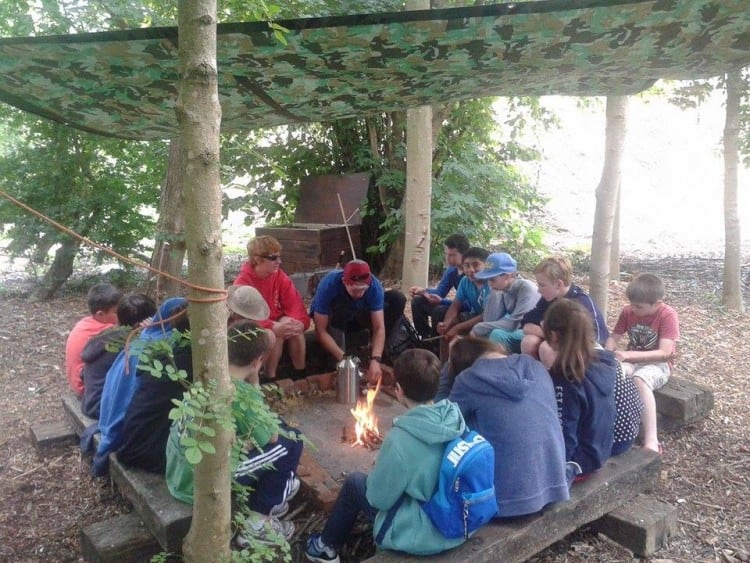 ns in a survival situation, like making and lighting your own fire, finding a suitable place to build a shelter and learning how to design and create a shelter. As an option you can make a warm drink over the fire or even toast marshmallows. Please note that dietary requirements/allergies must be advised prior to the visit. Without this information we are unable to include this in the session.
Number of participants: max 24 students per session depending on space
Age: 8 years+
Time Scale: 2hour – 3hours
Venue Requirements
Any suitable site that will allow the group safe movement and operation.
Grass area for shelter building
Well ventilated open space for fire lighting.
Bushcraft Experience Promotes
Resilience
Not giving up, working in a challenging environment, encouraging others and recognising their achievements.
Self-Aware, Confidence and Well Being
Understand basic survival principals, including how to prioritise and react to situations. Step back from the modern, digital world allowing nature to have a soothing quality that can help boost mood and reduce feelings of stress and anxiety. Listening to and following instructions. Keeping yourself safe, being patient and taking turns. Develop an understanding of associated hazards.
Environment Awareness
Understand environmental impact and leave no trace principle.
National Curriculum links KS2
English
Learning new vocabulary e.g. flint striker, fire triangle, fuel, environmental impact. Use descriptive English.
Discuss and evaluate what has happened during the session and take away feedback to build on for the future.
Science
Recognise that living things can be grouped in a variety of ways.
Understand basic needs for survival.
Explore and use classification keys to help group, identify and name a variety of living things in their local and wider environment
Recognise that environments can change and that this can sometimes pose dangers to living things.
Art and Design
Produce creative work using natural materials, exploring their ideas and recording their experiences.
National Curriculum links KS3
English
Learning new vocabulary e.g. flint striker, fire triangle, fuel, environmental impact. Use descriptive English.
Discuss and evaluate what has happened during the session and take away feedback to build on for the future.
Science
Scientific attitudes and evaluate risks
Ask questions and develop a line of enquiry based on observations of the real world, alongside prior knowledge and experience to help understand basic needs for survival. Recognise that environments can change and that this can sometimes pose dangers to living things.
Compounds and changes of state by introducing ‘The Fire Triangle’ and ‘6 ways you can light a fire’
Art and Design
Produce creative work using natural materials, exploring their ideas and recording their experiences.
Personal Social Health & Economic education (PSHE)
Understanding risk in both positive and negative terms and understanding that individuals need to manage risk to themselves and others in a range of situations.
Appreciating that pressure can be used positively or negatively to influence others in situations involving risk.
If you have any questions please contact us.
